THE HOLISTIC VIEW
Every position is full of details. Some of them can be really important, as is it the case with tactical threats or opportunities. Besides paying attention to the details, we also have to be aware of the big picture. What is the strategic frame work? What is the logic of the position? Only with a bird’s-eye view are we able do assess the position correctly an come up with the appropriate plans. The better the overall understanding, the better guided are your thoughts. If you know what is essential, you don’t waste time with unimportant side topics.
217. How is the evaluation of the position in terms of pawn units?
Even though it might be difficult sometimes, it is desirable to have a good idea about the evaluation of the current position. This will help you to set the right goals. Do I have to play for equality or can I be more ambitious? Is my advantage big enough to play conservatively? By the way, it is a very good training method to guess the pawn unit count before switching on the engine.
218. How does the evaluation curve look like?
Not only the present evaluation of a position is important, but also the past. It might give you hints with regard to the psychological situation at the board. If the position is equal after one side was clearly better, this could mean that the player who lost his advantage might still want to play for a win (winning back what “belongs to him”), whereas his opponent is content with having escaped a potential loss. If you perform a game analysis without engine, one of the main tasks is to draw an evaluation curve and pin point the turning points.
219. How is the qualitative distribution of values?
The pawn units indicated by the engine give us information about the quantitative distribution of values. When assessing a position, however, it is of the utmost importance to also know how the values are distributed in qualitative terms. You should know who is better in each single area of value, given there is no equality. The following table provides us with a rough overview.
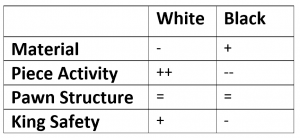
In this example White obviously sacrificed material for activity. As the material deficit is small (only a single -) it could be a pawn sacrifice or less (e.g. rook against minor piece + pawn). As there is a ++, White’s overall activity must be significant and translates to decent attacking chances (single +). In terms of pawn structure no one has the advantage. That doesn’t mean that the pawn structure is symmetric. Maybe, both players have one or two weak pawns. Or one has an isolated pawn and the other player suffers from doubled pawns. The overweight in pluses suggests that White has more than enough compensation for the sacrificed material.
220. Which are the winning ideas for both players?
Even if the position is equal, you should have an idea of how you want to win the position. The qualitative value distribution indicates what’s possible. In general, you want to push your advantages and prevent your opponent from doing the same. Ambitious players should try to play strategically demanding opening. The more complex an opening is, the more winning ideas exist. In the Scheveningen-type Sicilian I detected 25 winning ideas for Black after some brainstorming (see here). Further research would certainly bring forth more of them. Another opening I like a lot is the Classical Caro-Kann (4…Bf5). There I detected 15-20 winning ideas for Black (see here) depending on whether you include typical tactical motifs or not.
221. Who has the static advantage, who the dynamic advantage?
It makes a lot of sense to categorise the individual types of advantages into static and dynamic ones. A static advantage is long-lasting, which could be extra material or the better pawn structure. A dynamic advantage is time-related and involves topics such as initiative and attack. Then, there are borderline cases. If you destroy the opponent’s pawn shield with the effect, that his king is notoriously weak, not having a single safe hiding place on the board, then you generate static effects. Enemy forces are tied up to the king’s defense, as the pawn shield cannot do this job anymore. Exploiting the potential absence of enemy pieces, however, requires dynamic action (attack).
If we look from the perspective of the static-dynamic spectrum, there are four different conditions:
- The better side has a static advantage.
- The better side a dynamic advantage.
- The better side has both, a static and a dynamic advantage.
- One side has a static advantage, the other side has a dynamic advantage (both sides could be better overall or the position could be equal).
222. What do I do with my dynamic advantage?
“When a sufficient advantage has been obtained, a player must attack or the advantage will be dissipated.” – Wilhelm Steinitz
As a time-related advantage can easily evaporate, we cannot linger and allow our opponent to consolidate his position. Our goal must be to play energetically and convert our dynamic advantage into a static one. This could be a check mate, material gains or damages in the opponent’s pawn structure.

223. How do I meet the dynamic advantage of my opponent?
A dynamic advantage on the part of our opponent means that we are in immediate danger. We must be alert to potential threats and play defensively. Prophylactic thinking should be our modus operandi. We should strive to reduce our opponent’s dynamic potential through exchanges and strengthen our soft spots.
224. What do I do with my static advantage?
Whoever has the static advantage owns the future. He only has to live long enough to see it happen.
With a static advantage I don’t have to hurry, as it is substantial in nature. Also, the way to increase or to unfold it is easy. You don’t have to find something extraordinary or engage in dangerous tactical skirmishes. With have a material advantage you tend to exchange material. If you have space advantage you try to squeeze your opponent. If you enjoy the better pawn structure you push your advantage in this area, e.g. by besieging your opponent’s weak pawns.
Your primary goal is to maintain control of the position. As the future is rosy, you want to be conservative. Stifling counterplay or any kind of dynamic action is of utmost priority. One of your goals is to reduce the dynamic potential of your opponent by exchanges, particularly with regard to the queens.
225. How do I react to the static advantage of my opponent?
Playing against a static advantage is like standing on a slippery slope. The trend is against me and every move I let go by passively gives my opponent the opportunity to tighten the grip. I have to break the trend with decisive actions and I have to do it quick!
Attacking is one of the best methods when having a static disadvantage. Another one is bringing about tactical complications of some sorts. In order to seize the initiative, I cannot be too shy. Sacrificing material is sometimes the only way to go. If I linger, my opponent might have consolidated his position to a point, where all chance for action has been forfeited. Long-term suffering in a miserable endgame could be the consequence.
There is also a psychological aspect to it. The owner of a static advantage often considers himself as a big favorite of winning the game. Bringing about complications bears the chance of unsettling him emotionally, when he suddenly realizes that his firmly anticipated point is open for debate.
226. Which side should I take in the match-up “static versus dynamic advantage”?
In many openings you are on one or the other end of this famous confrontation. Your first duty is to be aware of this very fact. None of the sides is by definition better than the other. It depends on your style where your preferences lie. An attacking player might prefer the dynamic advantage, whilst a positional player would tend to opt for the static side. In the best case you have educated yourself to the level of a universal player who can play every such openings with either side.
227. What pace does the position have? What is the value of a single tempo?
Of course, you should be aware of the nature of the position (opening) in terms of pace. Some positions require fast and active play, whereas in others there is time for lengthy maneuvering and a need for patience. Most positions are somewhere in the middle.
228. What themes are effective in a position?
You can compare a game of chess with a symphony or a piece of literature. Over the course of time, different themes pop up and sometimes vanish again. Normally, two or more themes exist simultaneously. Let’s say the theme king safety is effective, as one side has a damaged pawn shield. At some point, this player manages to force the exchange of queens by means of a tactical ploy. Suddenly the theme king safety disappears and never pops up again.
229. Is there a main theme?
Often, there is one dominating theme, which dwarfs all the other ones. Let’s say there is a position with different pawn majorities. In most cases the dominating theme would be the question, who can profit more from his specific majority. If you don’t recognize the main theme, you will be in a world of pain.
230. Do I have a multifunctional move?
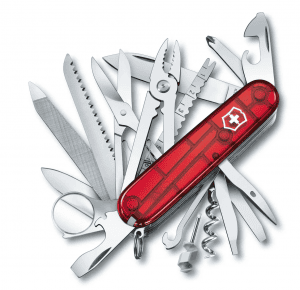
Seeing the position as a whole will make you understand all positional goals for both players. This in turn will enable you to find multifunctional moves. Hitting two or tree birds with one stone is what strong players often do and what you could be very proud of in your own games.
231. Is this a critical position?
It is important to detect critical positions, as there you have to spend more time than usual. Depending on the exact definition, in a game of 40 moves there might be ten, nine or eight critical positions. A position is critical, if it can decide the fate of the game. This makes all tactical positions critical. From a positional point of view, a position where you have to make a qualitative decision and set the course of the game can be considered critical. Let’s say you have to decide about exchanging queens or shaping the pawn structure. Both has a big impact on the game. In these positions, you have to spend a lot of time assessing the different options and coming up with a plan. In the phases between critical positions the plan will be roled out. Here, you shouldn’t spend too much time.
232. What metagame aspects do I have to take into consideration?
The metagame is a layer of decision-making above the evaluation of the engine. It includes subjective goals originating from a tournament- or match situation or the rating difference of both players. It also deals with psychological or resource-related aspects. I will deal with this topic in depth at a later point in time.