1.e4 e5 2.Nf3 Nc6 3.Bb5 a6 4.Bxc6 dxc6 5.0-0 Qf6!
After 5.0-0, there is no shortage of alternatives. 5…Bg4, 5…f6 and 5…Bd6 are of high quality and 5…Qd6 or 5…Be6 are also playable. However, my repertoire suggestion stands out from this group, as it has by far the best success rate at 45.7% (from White’s perspective). Black actually scores significantly more than 50% of all points.
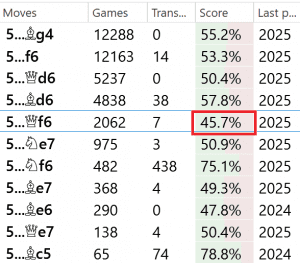
I have identified three reasons for this:
1. The surprise effect
5…Qf6 ranks only fifth in frequency and thus possesses a certain surprise potential.
2. Negative options
White gets plenty of opportunity to go wrong in this line. The presence of bad options for the opponent is naturally a quality feature, which is not reflected in the engine evaluation, but certainly shows up in the point scoring.
3. Positional depth / optical illusion
I have a preference for variations in which my advantage cannot easily be recognized as such by the opponent, which naturally leads to disorientation. Examples of this are the Hedgehog setup or Caro-Kann with 4…Bf5. In both cases, the space advantage can lead to a significant overestimation of White’s position. In our 5…Qf6 variation, White often gets exactly the late middlegame with the better pawn structure that he is aiming for. Instead of standing somewhat better, however, he sometimes stands slightly or even clearly worse. A middlegame is not an endgame after all, and besides, the exact arrangement of the pieces naturally plays a major role.
If you are interested in my analysis, you can buy the current and the following two editions of the German magazin “Schach”. Besides that, you can contact me for any kind of opening request or have a look at the specific subsite (click).
.