425. Should I copy the 2700-players?
“The new is rarely the good; for the good is only briefly the new.”
Already Schopenhauer criticized the human weakness for new things or fashion. People waste time on reading newspapers instead of extracting more substantial knowledge from books. If you use chess magazines for entertainment, it’s okay. Don’t confuse reading them with hard training, though. Closely following the world elite players doesn’t yield a lot of benefit, compared to targeted training of distinct chess topics. It might be okay to get inspired by elite players, but don’t slavishly copy what they are currently playing. First of all, it might be too difficult or doesn’t suit your style. Then, abandoning what you have learnt for a new thing, only because it is fashionable is very time-consuming. Also have on mind that the current fashion is being scrutinized by many.
426. Am I a genuine 1.e4 player?
Many players start out with 1.e4, as this move was recommended by their first coach. Either, the coach played 1.e4 himself or he knew teaching 1.e4 to beginners makes sense, as it gives them the best chance to learn tactics. Even if the move 1.e4 played a useful part in the development of the youngster, it doesn’t mean that the matured player has to stay loyal to this move forever. Many positional players would might do better with 1.d4 or 1.c4 instead. In the preface of his work “The Sicilian Labyrinth” Lev Polugaevsky states, that the Sicilian Defense is the litmus test for the 1-e4-player. While a true 1.e4-player embraces the battle arising in the Open Sicilian, the fake ones dislike that challenge and rather resort to some kind of feeble anti-Sicilian.
427. Should I consider a switch from 1.e4 to 1.d4?
As the saying goes, “Better a terrible end than a terrible situation with no end in sight.” If your results with 1.e4 are bad and you feel that you would be better off playing 1.d4 (as a classical player) or 1.c4 (as a modern player) with your positional style, then you should do the switch. Many players are too lethargic for this, but they cannot be helped anyways. If you are full with ambition and energy, then don’t linger. Of course, you don’t have to jump into the cold water. You will continue to play 1.e4, as long as you didn’t learn the basics of your new move. Also, will you make it opponent-dependent. If you like what your opponent plays against the new move, you will feel inclined to risk it. That way, you will be slowly growing into it. Online blitz games will help to speed up the process. If you return to chess after a long period of absence, the switch will be even easier to do, as you don’t have to leave behind that much. Your old theory has been forgotten or has become obsolete for the biggest part. Also have in mind that moving away from 1.e4 becomes more reasonable the older you get. 1.d4 or 1.c4 means less tactics and less theory to remember.
428. Should I abandon an opening after a loss?
As you will suspect, this is not a serious question. However, some players do just this. They want to flee from the pain of the loss and don’t want to be reminded of it by repeating the same line. Others may want to demonize the opening in search of a scapegoat. All this means ignoring reality and hence is, by definition, the wrong approach. Most of the time, the loss has nothing to do with the quality of the opening but with its interpretation. As with software, in the vast majority of the cases not the application is to blame but the user. Analyze your mistakes and then repeat the line with a better understanding of the position. Especially if you just have learned a new opening, you cannot expect to master it right from the start. Learn from your mistakes and build up expertise. Only then can you decide, whether the opening fits your style or is really not your cup of tea.

429. What is the benchmark with regard to the win rate?
On average the four big white opening moves 1.e4. 1.d4, 1.c4 and 1.Nf3 have a win rate of roughly 54%. Strong white openings (that assumes bad black lines as a prerequisite) perform better than taht and strong black openings are closer to 50%. Using the win rate in the statistic function of big data bases gives you a strong hint where to find quality. Have in mind that the statistical values can be distorted by bad variations for either side on a lower level (later move). Hence, you have to look out for such polarizations. Also note that the player quality can influence the results. For that reason, the Sicilian Defense performs much better than the move 1…e5 in the statistics. 1…e5 is played by many inexperienced players, while 1…c5 is preferably chosen by experts. Simply combine the statistics with the evaluation of your engine and you are on a good path.
430. Should I conduct a statistical analysis of my variations?
Some of your variations may underperform without you being aware of it. A statistical analysis will bring those Elo-leaks to light. If further investigation will show that the disappointing success rate is not the result of too little preparation but a consequence of a low quality or a lack of harmony with your playing style, such variations should be substituted by more suitable ones.
431. Do I consider “playability” when choosing variations?
With “playability” I refer to the degree of easiness when it comes to finding the right moves. Sometimes you might want to play a variation with White, where the engine only gives 0.00. This evaluation assumes that your opponent will find one or even a bunch of correct moves. In complex positions this can be a very hard task to do. For this reason, it might be a good idea to prefer this complex variation to an alternative line with the evaluation 0.25, if it is easy to play for your opponent.
432. Do I use digital tools?
In 1994 I stopped studying chess conventionally and went fully digital. Here are the advantages of digital work:
- You are several times faster compared to working with book and board
- You can invest the time saved in going over the subject matter several times. As we now, repetition is a key element of learning.
- You can actively work with the material by performing analyses with the engine.
- You can work with big databases and include many games.
- You can keep your material up to date, either by including more information or alter old one.
- You can prepare much better when being on a tournament and also don’t have to carry books with you.

433. Should I work with ChessBase?
Some platforms, such as Lichess offer database functions free of charge. For the majority of chess players, this appears to be sufficient. If you are a very serious player, however, using a commercial database program definitively is the way to go. Don’t cut corners at the wrong place.
434. Which package should I buy?
If money is no object, you can buy the program together with the MegaBase. In most cases, however, I would recommend the program together with the BigBase. The difference is that it doesn’t contain annotated games. Personally, I don’t need annotations, as I analyze everything by myself, assisted by the engine and the statistical functions. Older annotations in the MegaBase may be outdated, due to the rapid development of the engines in the last ten years. Such faulty annotations would be quite a burden for me. But maybe you appreciate the text comments in any case. Hence, it is a very personal matter which package to buy.
435. Do I need the online database?
The biggest public database is the online database running on the servers of ChessBase. Now the question arises, whether one should subscribe to this service or not (the abovementioned MegaBase packet includes one year of subscription, the BigBase package 6 months). Do I need the online database if I already have the MegaBase or BigBase on my hard drive? What are the differences? The online database
- contains considerably more games than the MegaBase
- before all, it contains the precious correspondence games
- it is always up to date (daily maintenance)
- the search function operates via position, not via key (transpositions are included)
Hence, for opening-related affairs I clearly prefer the online database. The MegaBase or BigBase is important for search operations with regard to middlegame aspoects (pawn structures, maneuvers, material distributions etc.) Hence, it may be worth having both, depending on your requirements.
436. Do I digitize books?
Sometimes books are not made available as pgn-files. In this case you can consider to digitize them. You create one variation tree per chapter and include the symbolic comments of the author. Add verbal comments at will. The work you invest in the creation of your tools can be considered as training at the same time, as you pick up a lot of patterns.
437. What do I do if I want to find an idea in a position?
When analyzing with an engine you might wonder what would be your next move if you were to move again. Here we come to one of the most simple and powerful functions of ChessBase. Simply press the x-key and your engine will skip the opponent and suggest your next move.

438. How do I find a long-term plan?
Sometimes you investigate a rather calm position with not much enemy contact and wonder what your next five moves could be. For this request, you use ChessBase’s Null Move function. Just let the engine make five moves in a row and you see how you could make progress.
439. What is the third criterion besides win rate and engine evaluation?
To the right of the statistical values, such as frequency, win rate etc. ChessBase gives a list of current top-class games. When in doubt, I look at this list and see which move appears most frequently.
440. Can I create my own icons for the database window of ChessBase?
Creating you own icons is a lot of fun, at least for me. You can see examples of that at the top of this page and at the top of the previous posting. Here are the steps you will have to conduct:
1. Design a square graphic (256×256 pixels is ideal), using a graphics or icon editing program
2. Save it in the .ico format and name the file to match your database name
3. Place it directly into the same folder directory on your hard drive where your database files are stored.
441. How to assign a very small advantage to a move?
There is one informator symbol missing. What, if the position is somewhere between “=” and “+=” or “=+”? The engine will give you a “=”, but one party is on the better side of equality, is having an edge. It would be good for the reader to receive this information. Again, I work around that deficit by attaching a vertical arrow. This normally means “initiative”, but as I don’t need it in this function, I use it for my own purposes. Actually, it is not that far from its original meaning, as having an edge is equivalent to having a positional initiative.
442. What information should I add to my analysis?
As I mentioned many times before, studying chess is about understanding the logic of a position and absorbing important patterns. Whenever you make a discovery or observation you deem interesting, make a note in one way or the other. Using symbols is a quick way to annotate. A double click on a move in the notation opens a text window for you to verbalize your ideas. You can also highlight squares in green, red and yellow or draw arrows in the same colors, indicating moves, piece paths, threats, weak points and so on.
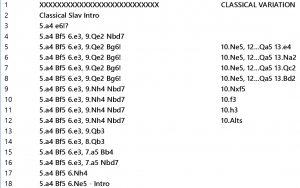
443. How can I order my data in ChessBase?
As I have many analyses (variation trees), e.g. 350 for the Caro-Kann alone, I use one database for one major opening. The same applies for middlegame or endgame topics and for my clients’ data etc. All in all I work with over 100 databases.
ChessBase organizes your repertoire with a tree function. I personally, starting in 1994, chose a different path. Whenever a software doesn’t provide you with what you desire, there might be a way to work around it. I used the input fields for “White” and “Black” to insert the defining moves of my opening line. As a result, all my lines are listed neatly in a list, with the differences clearly visible (see above picture).
If you have a database with different topics (e.g. weak pawns, weak squares, pawn breaks etc. in your middlegame database), you can separate them by the following method. Use an empty game and provide it with a name (using the input field for “White”). Now, mark it with a color (medal) of your choice (for this to be possible, you have to make one single move) and you have a nice separator/header for your topics.
444. How to prepare for an opponent?
Here, I just want to comment on the technical aspect. ChessBase provides you with a tree function, displaying your opponent’s moves according to frequency. For me this is uninteresting. I prefer to merge all the games of my opponent with the respective color into one single variation tree. Now I can manipulate this tree according to its interaction with my own variations. I downgrade the irrelevant lines or even delete them. Whereever I think a potential clash of our repertoires could happen, I create a diagram. With the engine I might perform some short analyses to get some quick clarity. After I have found out where I can get the most equity or the most promising position, I create a new variation tree (in case it doesn’t already exist) in my opening databases and analyze this variation.
This method has two advantages compared to ChessBase’s automatic tree function. First, I can see exactly when certain lines was played. If the games are very old, chances are my opponent has abandoned this line. The second advantage is that I can structure my variation tree, add comments and analyze some positions. The tree will be saved for future encounters. Thus, I won’t have to start on square 1 again, but can build on my work already done, incorporating recent games.